
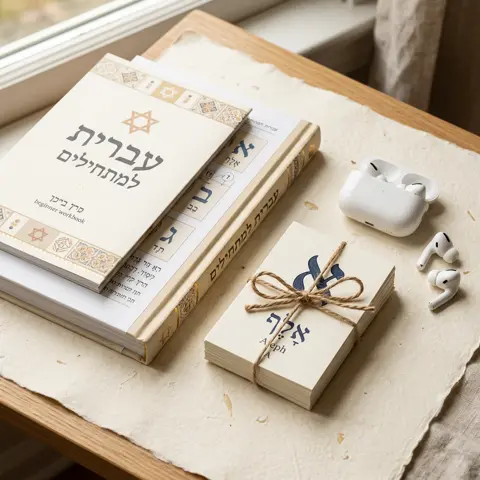
 Complete Starter Kit
Beginner
Ultimate Hebrew Beginner Bundle (3-in-1)
Includes Beginner Workbook, 200 Flashcards Set, and Pronunciation MP3 Audio Guide.
$49.00$75.00
By Elisahar, native Hebrew speaker 5 min readUpdated November 4, 2026
Quick answer
Every Hebrew noun is either masculine or feminine, and adjectives, verbs and numbers change to match it. Feminine nouns usually end in ־ה (-a) or ־ת (-t), masculine plurals usually end in ־ים (-im) and feminine plurals in ־ות (-ot). You also change verbs and "you" depending on who you talk to: אתה ata to a man, את at to a woman.
Tap the speaker next to a Hebrew word to hear it. Words without a native recording yet use your device’s Hebrew voice.
Nouns ending in ־ה (-a) or ־ת (-t) are usually feminine, and most other nouns are masculine. A handful of common words break the rule, so learn them as exceptions:
| Hebrew | Say it | Meaning | Gender |
|---|---|---|---|
| ילד | yeled | boy | masculine |
| ילדה | yalda | girl | feminine (-a) |
| מחברת | machberet | notebook | feminine (-t) |
| עיר | ir | city | feminine (exception) |
| ארץ | eretz | country, land | feminine (exception) |
| לילה | laila | night | masculine (exception) |
| יד | yad | hand | feminine (body pairs are usually feminine) |
The adjective comes after the noun and takes the same gender and number:
| Hebrew | Say it | Meaning |
|---|---|---|
| ילד גדול | yeled gadol | a big boy |
| ילדה גדולה | yalda gdola | a big girl |
| ילדים גדולים | yeladim gdolim | big boys / children |
| ילדות גדולות | yeladot gdolot | big girls |
A mixed group of men and women uses the masculine plural. Some plurals do not follow the usual ending: נשים nashim (women) is feminine, and שולחנות shulchanot (tables) is masculine, but their adjectives still follow the real gender: נשים חכמות nashim chachamot (smart women).
| Hebrew | Say it | Meaning |
|---|---|---|
| אתה כותב | ata kotev | you write (to a man) |
| את כותבת | at kotevet | you write (to a woman) |
| אתם כותבים | atem kotvim | you write (to a group of men or a mixed group) |
| אתן כותבות | aten kotvot | you write (to a group of women) |
Even "I" changes the verb: a man says אני כותב ani kotev, a woman says אני כותבת ani kotevet. Learn verbs in both forms from the start.
When counting things, the number matches the noun, and the forms can look reversed: the masculine number often ends in -a.
| Hebrew | Say it | Meaning |
|---|---|---|
| שלושה ילדים | shlosha yeladim | three boys / children |
| שלוש ילדות | shalosh yeladot | three girls |
For prices, phone numbers and counting out loud, Israelis use the feminine numbers: achat, shtayim, shalosh.
Prefer video? Watch more Hebrew lessons on the Hebrew With Elisahar YouTube channel.
Not sure where to start? Take the free level test.
Complete Starter KitIncludes Beginner Workbook, 200 Flashcards Set, and Pronunciation MP3 Audio Guide.
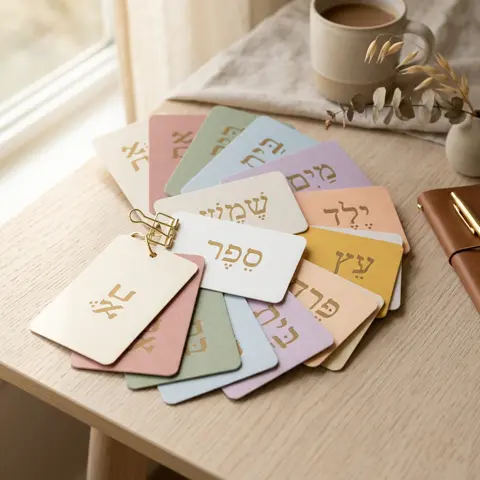 Printable PDF
Color-coded cards for daily words, food, shopping, and travel with transliteration.
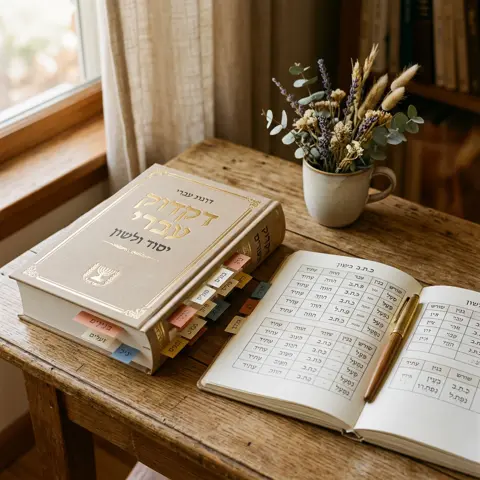 Grammar Master
Complete guide to all 7 verb structures (Binyanim) with practice exercises.